
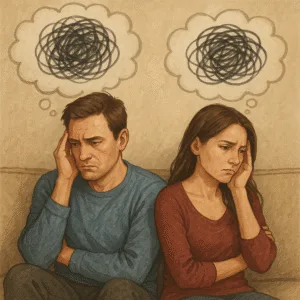
Relationships are tricky, especially when you’re trying to make them last. There’s so much that can go wrong, and our natural bias toward negativity often pushes us to focus on what isn’t working instead of what is.
As a counselor and coach, I often find that many relationship challenges aren’t caused by the differences themselves—but by the stories we tell ourselves about those differences.
Consider a few common examples:
- Spender vs. Saver: One person feels disrespected because their partner spends too freely, while the other feels controlled by restrictions.
- Connection vs. Freedom: The connection-focused partner may assume their partner doesn’t love them if they want time alone, while the freedom-focused partner feels smothered.
- Different Love Languages: A partner may be showing deep love in their own language (Acts of Service, for example) but their partner, craving Quality Time, doesn’t recognize it.
- Introvert vs. Extrovert: The introvert may believe the extrovert doesn’t want to be alone with them, while the extrovert may assume the introvert doesn’t care about meeting friends and family.
None of these differences are inherently problematic. The trouble starts when we assign negative meaning—telling ourselves our partner doesn’t care, doesn’t respect us, or isn’t committed.
I’ve lived this myself. In my marriage, I was a Quality Time person while my husband was an Acts of Service person. I felt he didn’t want to spend time with me because he was always busy fixing things, while he wondered why I wasn’t cooking or doing other tasks. Thankfully, before he passed, we figured it out. He came to understand that I did love him, and I came to recognize the many ways he had been showing his love all along.
I’m also fascinated by how other systems highlight these dynamics. For example, Dr. Gary Sanchez’s WHY.os framework—while often used in the workplace—applies beautifully to relationships. When partners have conflicting “whys,” misunderstandings can multiply unless they learn to communicate through them.
The point is this: differences in relationships are inevitable. What determines whether those differences bring you closer or drive you apart is the story you create about them.
When you find yourself personalizing your partner’s behavior, pause. Ask yourself:
- What story am I telling myself about this?
- Is this story true—or is it just my interpretation?
- Could there be another explanation
By questioning those stories, you shift from automatic sabotage to intentional communication. Instead of assuming the worst, you open the door to negotiating solutions that honor both of your needs.
Differences don’t have to mean disconnection. With awareness, curiosity, and a willingness to rewrite the stories in your head, your relationship can grow stronger—even because of those differences.